On this page · 4 sections ▾
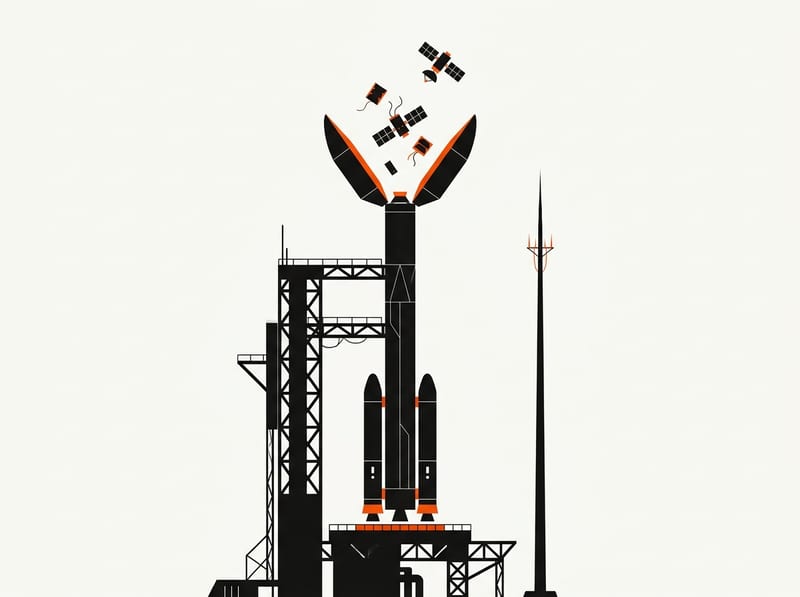
United Launch Alliance's Vulcan rocket failed to reach orbit on November 15, destroying the 40 Amazon Leo broadband satellites it carried. ULA said the rocket suffered an anomaly 10 minutes into the flight. According to Ars Technica, it was the company's first total mission failure since its formation in 2006.
Key facts
- Vulcan lifted off from Cape Canaveral Space Force Station in Florida at 17:40 UTC on November 15, per Ars Technica.
- The payload was 40 Amazon Leo satellites, on the first of 38 Vulcan launches Amazon booked, The Verge reported.
- ULA has not identified a cause. Ars Technica's sources placed the problem in the booster stage, not the Centaur V upper stage or the solid rocket boosters.
- The twin BE-4 engines, supplied by Blue Origin, reportedly kept burning at least 30 seconds past their planned shutdown near the five-minute mark.
- Amazon Leo has 396 satellites in orbit out of a planned 3,292 first-generation spacecraft, according to Ars Technica.
What happened
Ars Technica reported that the six solid rocket boosters appeared to perform well and were jettisoned on time. The BE-4 engines then ran longer than planned, which could mean the booster stage was underperforming. A mission animation driven by live telemetry showed the vehicle starting to spin after engine shutdown, and the Centaur's two RL10 engines appeared to try to steer it back on course.
ULA ended its broadcast without discussing the anomaly and then posted a statement on X. It said it did not immediately have specific data on what occurred, and pledged transparency with customers during the investigation. Amazon said in a statement that there is risk with any launch, especially inaugural missions, and that it expects ULA to learn from the flight.
The flight was Vulcan's return after about nine months. Space.com had listed a November 13 target and noted that on two earlier flights, in October 2024 and February 2026, a solid rocket booster nozzle burned through. Vulcan still reached orbit both times. ULA said it had flown an improved nozzle design on this mission. Ars Technica says the new failure is a different kind, and the boosters were not the problem.
Why it matters
Ars Technica expects the failure to ground Vulcan for an indefinite period. The rocket is contracted to fly roughly half of the US military's national security space missions in the next few years. Earlier Vulcan delays already led the Space Force to move six launches to SpaceX, and Ars expects more swaps, deepening reliance on a company that plans to retire Falcon 9 as it shifts to Starship.
For Amazon, the 40 lost satellites matter less than the grounding of its main launch provider, Ars reports. It has 37 more Vulcan launches reserved. Its other options are 10 remaining Falcon 9 missions and Arianespace's Ariane 6, with the fourth of 24 contracted Ariane launches planned later in November. Amazon recently built its 1,000th satellite, so more than half sit in storage.
What to watch next
- The cause. If a BE-4 engine was at fault, Ars notes it could delay Blue Origin's New Glenn return to flight, which uses a similar engine. A May ground-test explosion of New Glenn was traced to a faulty valve on a BE-4.
- NASA plans. The agency recently chose a version of ULA's Centaur upper stage for future Space Launch System flights, with crewed lunar missions as soon as 2028. NASA will want the Centaur V ruled out. Its administrator told ULA the agency is available to assist.
- Amazon service timing. Amazon told Ars in October it had enough satellites to begin initial commercial service by the end of the year. Whether that holds has not been addressed in the sources.
- ULA's timeline. The company has said only that it wants to return to flight as quickly as possible. Earlier Vulcan reviews took months, per Ars Technica.