On this page · 4 sections ▾
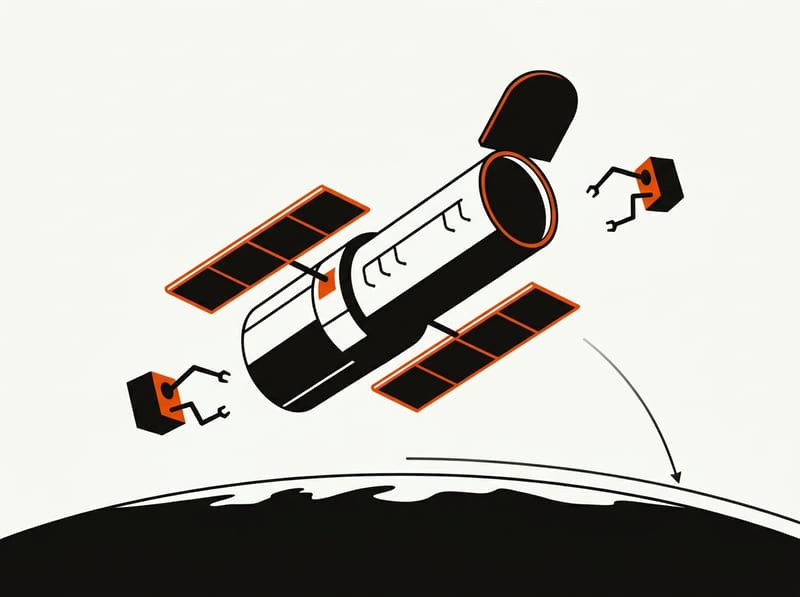
NASA issued a request for information to commercial space companies on October 29, asking how they could boost, service or safely deorbit the Hubble Space Telescope. Responses are due by 3 PM ET on November 30. NASA is not committing to buy a mission, and any mission would need to fly by 2032.
Key facts
- The request covers three options: boosting Hubble to at least 373 miles (600 km), enhancing its performance and lifetime, or a controlled reentry.
- Hubble now orbits about 292 miles (470 km) up. The shuttle Columbia last raised it, in 2002.
- NASA puts the chance of reentry at 10% by September 2032 and 50% by December 2033, according to The Register.
- The contractor would supply the launch vehicle, servicing spacecraft, mission operations and crew if applicable.
- NASA has no funding allocated to a Hubble reboost or servicing mission, per Ars Technica.
Why Hubble is running out of time
Hubble has no propulsion, so it has slowly lost altitude since the shuttle fleet retired. Ars Technica reports that orbital dynamicists expect reentry in 2033 or 2034 without intervention, though forecasts can shift with solar activity. The Register notes that increased solar activity can cause greater drag than expected, as the end of the Swift mission showed.
Without a boost, reentry would be uncontrolled. The Register says Hubble is massive enough to pose a remote risk to people on the ground. Ars estimates a boost to 600 km would likely keep the telescope in orbit for at least 25 more years.
There is also a science case. NASA says no replacement for Hubble's visible and ultraviolet capability is expected before the Habitable Worlds Observatory in the 2040s. Webb and Roman observe mainly in infrared. The Register adds that Hubble remains 7:1 oversubscribed.
Lessons from earlier attempts
The idea is not new. Ars reports that Jared Isaacman, then a private astronaut, proposed a SpaceX Dragon mission in 2022. NASA's own 2022 request drew eight responses, and the agency decided in 2024 not to pursue a reboost. Isaacman is now NASA administrator. In a NASA statement quoted by The Verge, he said that if cost-effective ways exist to extend an asset's life, NASA should explore them.
A crewed mission looks unlikely. The Next Web notes that SpaceX plans to retire Crew Dragon by 2030. Isaacman wrote on X that he expects interest from robotics companies, according to Ars.
Swift is the recent test case. Ars says NASA gave Katalyst Space Technologies a $30 million contract and nine months to reach and lift the telescope. Katalyst launched on time and got within about 6 miles (10 km), but ground teams stopped after power and reaction control problems. Ars says NASA would likely offer more money and time for Hubble.
One advantage for Hubble, per The Register, is a soft-capture mechanism fitted in 2009, which should make docking easier than the grappling planned for Swift.