On this page · 4 sections ▾
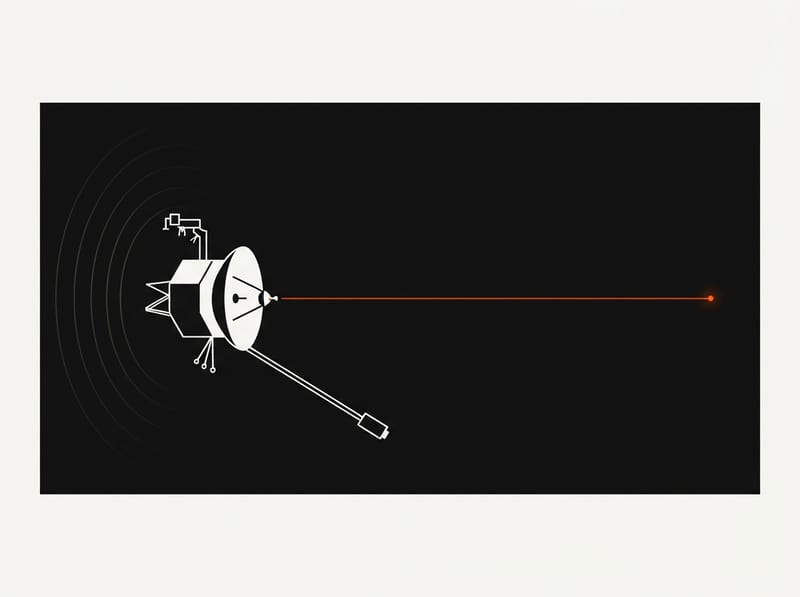
NASA's Voyager 1 probe passed a distance of one light-day from Earth at about 5:16 a.m. ET on Wednesday, November 18, 2026, according to The Next Web. It is the first human-made object to reach that distance, roughly 16 billion miles, so a radio signal now needs a full 24 hours to travel one way.
Key facts
- Crossing time: 5:16:07 a.m. ET on November 18, per TechSpot.
- Distance: one light-day is 16,094,799,096 miles (25,902,068,356 kilometers), TechSpot reports.
- Speed: about 37,844 mph, according to Tom's Hardware.
- Launch: September 5, 1977, 16 days after Voyager 2.
- Voyager 2 is expected to reach one light-day in November 2035.
A round trip takes two days
Because signals take a day each way, a command sent to Voyager 1 gets a reply only after two days. The Next Web quotes Suzanne Dodd, Voyager project manager at NASA's Jet Propulsion Laboratory, saying you send your message, go home, and wait two days for a response. The Next Web adds that NASA will only confirm the exact crossing time when the probe's reply arrives on Thursday.
The Verge, citing NASA, notes the probe is still sending readings on plasma waves, magnetic fields and particles. The Register reports that only two science instruments remain on, the magnetometer and the plasma wave subsystem. Others were shut down over the years to conserve power from the probe's radioisotope generators, whose output shrinks each year.
Why it still works
Garry Hunt, a member of the original imaging team, told The Register that the mission's success came from reliable, well-tested equipment and onboard fault protection. In his words, there was always a backup and always a safe mode. He also said Jupiter's magnetic environment turned out to be 1,000 times stronger than designers anticipated, which forced changes to the radiation protection.
The Register also recounts the probe's history: a Jupiter flyby in 1979, Saturn and Titan in 1980, and a final imaging sequence in 1990 that produced the "Family Portrait" including the Pale Blue Dot image. The Next Web adds that Voyager 1 became the first spacecraft to reach interstellar space in 2012. Voyager 2 followed in 2018, per TechSpot.
What to watch next
Voyager 1 is heading toward Gliese 445, a star about 17 light-years away in Ursa Minor. NASA expects it to pass within 1.7 light-years of the star in about 40,000 years, per The Next Web.
Near term, Space.com reports that JPL will host a moderated discussion with mission team members and NASA leadership on Thursday, November 19, at 12 p.m. EST. It will cover the status of both spacecraft and the engineering challenges of keeping them running. NASA will also preview a Voyager documentary planned for 2027, the mission's 50th anniversary.
The public "Shine Bright" event, held after sunset on November 17, asked people to flash the call sign VGR in Morse code. Space.com stresses it was symbolic: the flashes cannot reach the probe, which NASA contacts through its Deep Space Network.