On this page · 4 sections ▾
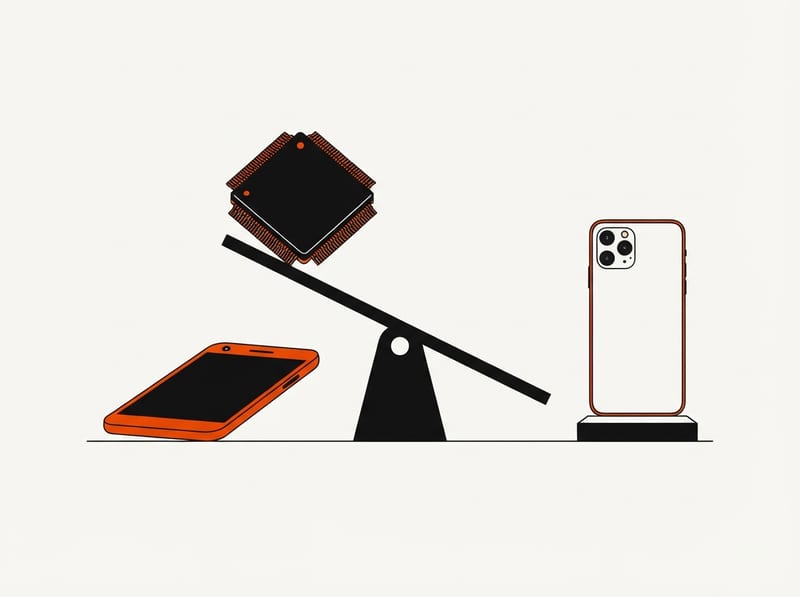
India's smartphone shipments fell sharply in the July-September quarter of 2026, as global memory shortages pushed up component costs and prices. IDC put the drop at 23.3% year over year, according to FoneArena, while CyberMedia Research (CMR) measured a 20% fall, as reported by India Today on November 18.
Key facts
- IDC counted 36.8 million units shipped, the steepest quarterly contraction since Q4 2022 and the weakest festive quarter in a decade.
- CMR reports a 20% decline, with phones below Rs 7,000 down 94% and the Rs 7,000 to Rs 24,999 band down 42%.
- Phones priced from Rs 25,000 to Rs 49,000 grew 38% and those from Rs 50,000 to Rs 1 lakh grew 32%, per CMR.
- IDC says average selling prices rose 26.1% to a record $371, while market value fell 3.3%.
- IDC expects Q4 2026 shipments to fall by more than 25%, with 2026 volumes at 125-127 million units.
Budget phones nearly disappear
Both firms point to the low end as the main casualty. IDC says the sub-$100 segment shrank 90.9% to 0.7 million units, and its share fell from 16.2% to 1.9%. IDC states that memory costs have changed the economics of entry-level devices so much that the segment has effectively left the market.
The $400-$600 band added around 1.4 million units, but the sub-$100 tier lost around 7 million, so growth in the middle could not offset the decline. IDC says financing options helped narrow the price gap between tiers.
Brand rankings differ by tracker
The two reports agree that Samsung leads, but the details differ. IDC says Samsung was the only top-10 brand to grow, up 7.9%, and returned to first place after 10 quarters. CMR instead shows an 8% decline for Samsung, with a 17% market share. The sources do not explain the gap, which likely reflects different methodologies.
IDC ranks the top five as Samsung, vivo, OPPO, Apple and Motorola. Apple's shipments fell 25%, but the iPhone 18 Pro and Pro Max accounted for over 30% of its volume, according to IDC. CMR gives Apple a 9% share and says the iPhone 17 series made up 53% of its shipments. CMR also reports declines of 25% for vivo, 28% for Xiaomi including POCO, and a similar fall for OPPO. It says OnePlus grew 27% and Ai+ grew 247%, both from small bases.
What to watch next
IDC expects further contraction in Q4 2026 as cheaper inventory runs out, and says a weaker rupee is adding price pressure. It expects second-hand phones to gain traction, and sees pressure continuing through 2027, with recovery unlikely before 2028.
IDC lists several signals for Q4: how quickly channel inventory clears after the festive period, whether 4G's rising share (10.4% from 9.5%) holds, and whether the $400-$600 tier keeps growing. Easing memory costs and wider EMI schemes could support a recovery, while memory supply constraints beyond 2027 could slow it.
For buyers, the data points to higher prices and fewer cheap options. For vendors, it favors firms with scale and reliable component supply. IDC notes that most Chinese brands have formed joint ventures with Indian manufacturers to expand local production.