Skip to content
techworthit
techworthit

One question, one number. TechWorthIt reads the world's tech reviews and reporting, then tells you whether it's worth your money, with every source linked.

How we scoreAboutContactPrivacyTermsRSS
© 2026 TechWorthIt · We may earn a commission from links. It never changes a verdict.
LatestReviewsDealsSearchSaved 0
SectionExplainers / Smart Home
AuthorTechWorthIt Desk
PublishedNov 10, 2026 · 3 min

How does Ring's cloud-piloted security drone actually work?

Ring's new indoor drone offloads its navigation brain to remote servers. Here is how that design works, what it makes possible, and what it costs in privacy terms.

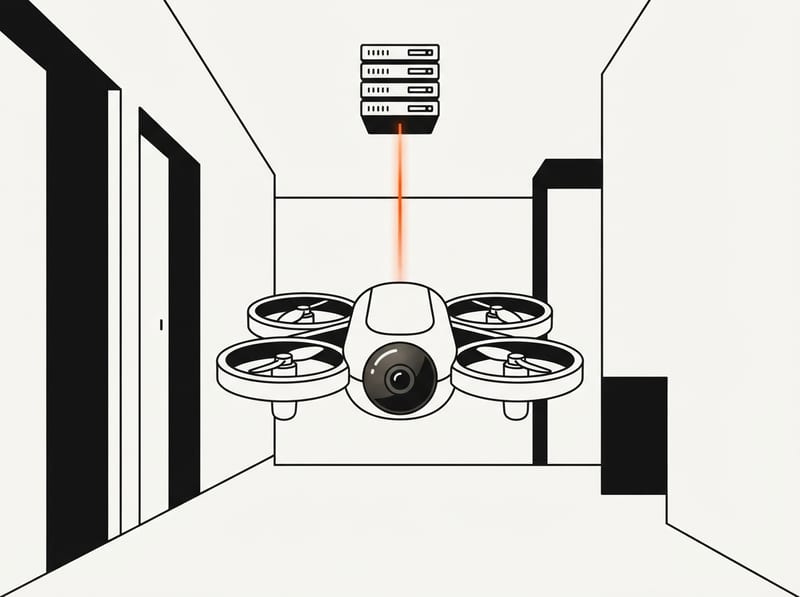
A small indoor camera drone hovers in a hallway while a thin beam of light connects it upward to a stack of remote servers.
Illustration
On this page
  1. Why not put the brain inside the drone?
  2. How does AI Pilot work?
  3. What does the design cost?
  4. Why does it matter now?
0% read
On this page · 4 sections ▾
  1. Why not put the brain inside the drone?
  2. How does AI Pilot work?
  3. What does the design cost?
  4. Why does it matter now?
TL;DR
Ring's Drone Cam is a 165-gram quadcopter that carries cameras and basic flight safety, while a cloud-based system called AI Pilot decides where it goes. Moving the thinking off the device cut weight and cost, but it ties the drone to Wi-Fi and to Ring's servers.

Ring's Drone Cam is an indoor security drone that does not think for itself. Cameras and sensors on the aircraft stream video to Ring's servers, and a cloud system called AI Pilot works out where the drone should fly. That split is what let a 165-gram flying camera reach a $249.99 price.

As Engadget reported, the drone ships on January 27, 2027, alongside the $999.99 Ring Rover Cam, a wheeled robot for businesses that uses the same software.

Why not put the brain inside the drone?

Ring tried. According to founder Jamie Siminoff, as relayed by Engadget and Wired, earlier versions kept hitting edge cases that required more sensors. More sensors needed more computing power, which drained the battery faster and added weight.

A heavier drone has to spin its propellers harder, which raised safety concerns and led to larger guards around the blades. Those guards let less air through and hurt flight performance. Siminoff said a fully self-contained version would likely have cost more than $5,000.

The fix was to take the heavy computing off the aircraft. A small drone is simple physics: less mass means smaller motors, a smaller battery and safer blades.

How does AI Pilot work?

Ring describes AI Pilot as a mix of vision models, sensors and cloud processing. Per TechCrunch, the system builds a map of a home or office by exploring it. ZDNET reports it then moves the device between patrol points a user sets in the app, such as a window or a side door.

The drone also draws on the Alexa Home Map, a 3D view of the house that Amazon announced last month. Instead of steering, a user taps a spot on the map and the system plans the route. Wired notes users cannot fly the drone manually, though they can set routes and schedules.

The flow is: a trigger, such as a motion or leak sensor, fires. The drone undocks and streams video to Ring's servers. The AI Pilot agent replies with direction. The drone avoids people and objects on the way.

Keep reading

News / Enterprise16d

Starlink and Starshield restored for Ukraine's drones, Kyiv says

Defense Minister Yevhenii Khmara says military links work again after a speed cap of about 10 days, but who ordered and lifted it remains disputed.

A flat satellite internet terminal on the ground connected by a cable to a small quadcopter drone, with a satellite visible in the sky above.
News / Smart Home9d

Apple HomeView code points to a HomeKit security camera mode

Strings in HomeView Software 27.2 describe motion detection, streaming and recording with HomeKit Secure Video, though Apple has announced none of it.

A small indoor security camera on a shelf sending signal waves toward a nearby smart display showing a simple abstract shape.

The aircraft keeps a small safety layer. Wired says it will land if it loses internet, and it runs a motor health check before every takeoff. Engadget adds that it returns to its dock or lands when the battery runs low.

What does the design cost?

Cloud control brings tradeoffs. The drone depends on Wi-Fi and cannot work outdoors. Flight time is short: Engadget cites eight to 10 minutes, while Wired and ZDNET cite five to eight minutes. Routes must therefore be brief, and the dock serves as both start and end point.

Privacy is the larger issue. Because video goes to Ring's servers, the company uses what it calls TAKE, or Throw Away the Key Encryption. Wired explains that video is encrypted in transit and keys rotate every few minutes, but Ring briefly holds the key so its cloud AI can process footage, then deletes its copy. That brief window makes it weaker than true end-to-end encryption.

Ring says the devices are built to be noticed. The drone is loud, which Siminoff framed as a safeguard: someone snooping remotely could not do it silently. Wired also reports that the Electronic Frontier Foundation's Thorin Klosowski urges buyers to think about how the device makes others in the home feel.

Why does it matter now?

The same cloud-first approach powers the Rover Cam, which Wired and The Verge describe as built on Astro hardware. Amazon discontinued the Astro for Business roughly a year after launch, so Ring is betting that better software, not different hardware, was the missing piece.

For readers, the lesson reaches beyond this product. Small, cheap robots increasingly act as eyes and legs for a remote AI. That makes them affordable, but it also means the device is only as useful, private and durable as the service behind it. Wired notes buyers face a risk that Amazon could pull the plug if Ring Robotics does not pan out.

The news behind this
Ring launches $250 Drone Cam and $1,000 Rover Cam security robots →

Sources

  • EngadgetAmazon finally launches the $250 Ring Drone Cam and also the Ring Rover Cam↗
  • The VergeAmazon turned its Alexa robot into a Ring security patrol bot↗
  • TechCrunchRing, known for its doorbell cameras, launches a home security drone and an enterprise security robot↗
  • WiredRing’s Indoor Drone Camera Is Back—and Now Powered by AI↗
  • ZDNETRing’s new drone patrols your home to keep an eye on things – even upstairs↗

HOW THIS WAS MADE · Written by the TechWorthIt Desk with AI assistance from 5 published sources, linked above. Facts are cross-checked against those sources before publishing; we never claim testing we didn't do. Last updated Nov 10, 2026. Spotted an error? Tell us.

News / Smart Home13d

Amazon unveils Echo Show 16 and four other Alexa devices

Amazon's October 28 launch adds a $499.99 16-inch display, a camera-equipped Echo Studio, a hub-style Echo Dot, a bedside clock and a photo frame.

A large smart display with a blank-looking screen sits on a counter beside a small round smart speaker and a compact bedside speaker.
techworthit
01 Reviews02 Explainers03 News