On this page · 5 sections ▾
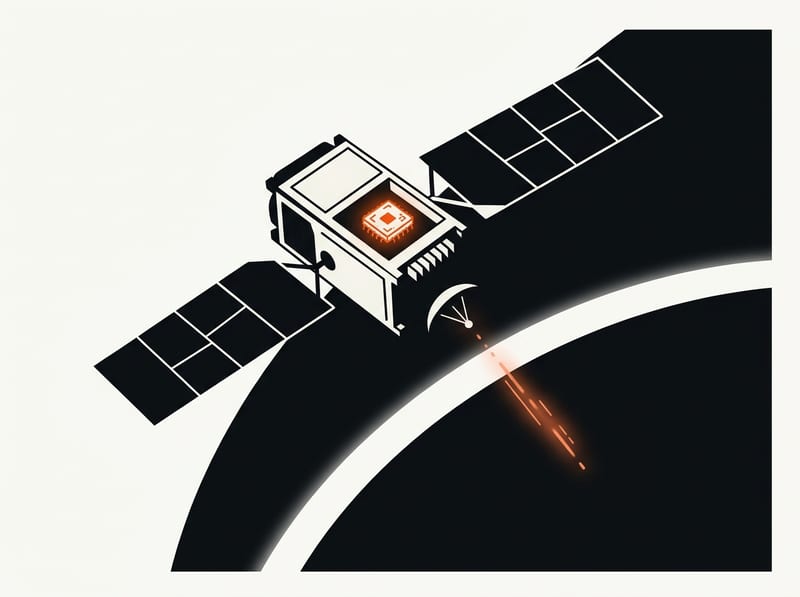
Google said on October 30 that its Project Suncatcher prototype satellite has run an AI prompt in orbit and sent the answer back to Earth. Engineers asked the onboard Gemma 4 model to write a haiku about being in space, the first complete inference response from the satellite's Tensor Processing Units (TPUs), according to The Verge.
Key facts
- The satellite launched on October 1 on a SpaceX Falcon 9 with more than 100 other spacecraft, per India Today.
- It carries four TPUs and generates up to 1 kW of electricity, but can run only one chip at a time, for about 20 minutes, according to TechCrunch.
- Commissioning of the satellite's subsystems took about three weeks before the first prompt.
- Two more satellites with higher power generation and inter-satellite optical links are planned for 2027.
What happened
The sources differ slightly on the exact prompt. TechCrunch and India Today describe a request for a haiku about being in space. The Register quotes a longer prompt asking for a haiku from the perspective of a TPU orbiting Earth. The Register also reports that Travis Beals, a senior director at Google, wrote that the prompt was uplinked during a ground-station pass and that the response came down as the satellite passed over Svalbard, Norway.
Google also tried space-themed limericks and telemetry prompts asking the payload to report its technical status. A Google spokesperson told TechCrunch the satellite was operating nominally. CEO Sundar Pichai called the result a "hello world" milestone, per India Today.
The open engineering questions
The next phase tests how the TPUs handle thermal stress and radiation. Radiation can cause bit flips, which may corrupt data without tripping normal monitoring.
The Register cites a paper Google researchers published earlier this month on lab testing with a 67 MeV proton beam. High-bandwidth memory was the most sensitive part, showing irregularities at a cumulative dose of 2 krad(Si), about three times Google's 750 rad(Si) minimum requirement. For typical transformer workloads, the researchers estimated a failure probability on the order of 1 per 3 million inferences, which they called likely acceptable for inference. They said the effect on training jobs requires further study, a conclusion TechCrunch and India Today echo.
Why the economics matter
The project is aimed at the 2030s. The Register reports that Google's calculations put launch cost amortized over a satellite's life at roughly $810 to $7,500 per kW per year if launch prices fall to $200 per kg, versus about $570 to $3,000 per kW per year for US terrestrial data center electricity. Google expects SpaceX could reach that price around 2035. The Register's own estimate, based on Starlink mass and a retail price of about $7,000 per kg, makes the first haiku an expensive one.
TechCrunch adds that Suncatcher is unusual in planning high-speed links between close-flying satellites to run coherent distributed workloads. It notes that Alphabet holds a significant stake in SpaceX, and that both companies depend on a fully reusable Starship. A peer-reviewed analysis estimated Starship would need to fly 1,800 times to reach the cost reductions seen with earlier vehicles.
What to watch
- Results of the thermal and radiation tests, especially any silent data corruption in orbit.
- Whether the single-TPU, 20-minute duty cycle improves on the 2027 satellites.
- Progress on Starship reuse, which TechCrunch says both Google's and SpaceX's plans require.