Skip to content
techworthit
techworthit

One question, one number. TechWorthIt reads the world's tech reviews and reporting, then tells you whether it's worth your money, with every source linked.

How we scoreAboutContactPrivacyTermsRSS
© 2026 TechWorthIt · We may earn a commission from links. It never changes a verdict.
LatestReviewsDealsSearchSaved 0
SectionExplainers / AI
AuthorTechWorthIt Desk
PublishedNov 7, 2026 · 3 min

What is a robotaxi like Tesla's Cybercab, and how does it work?

A plain explanation of what a robotaxi is, what makes a car with no steering wheel different, and why Tesla is giving factory space to one.

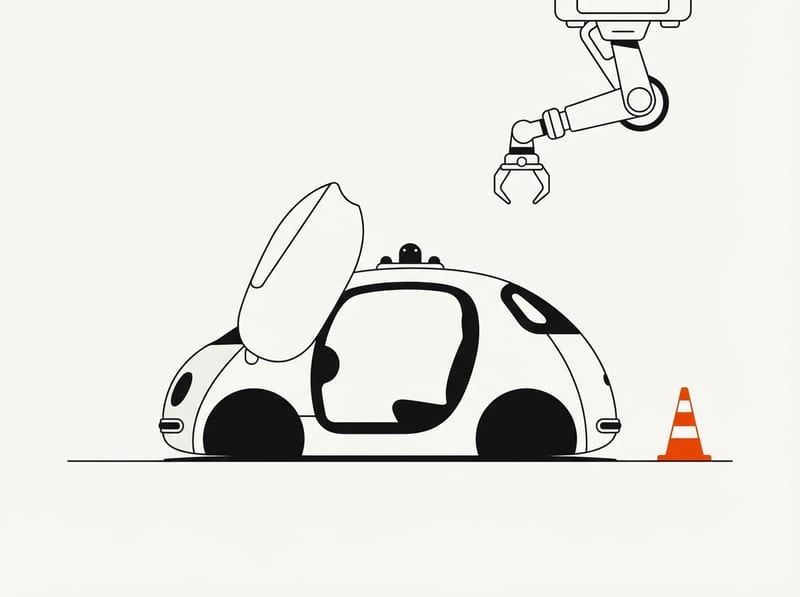
A small driverless electric car with open doors and no steering wheel stands on a factory floor beneath a robotic assembly arm.
Illustration
On this page
  1. Why is Cybercab in the news?
  2. How does a robotaxi work?
  3. What makes the Cybercab different?
  4. Why would a company build one?
  5. What are the open questions?
  6. What does it mean for you?
0% read
On this page · 6 sections ▾
  1. Why is Cybercab in the news?
  2. How does a robotaxi work?
  3. What makes the Cybercab different?
  4. Why would a company build one?
  5. What are the open questions?
  6. What does it mean for you?
TL;DR
A robotaxi is a car that drives itself and is summoned through an app, so riders pay for trips without a human driver. Tesla's Cybercab is a two-seat version built without a steering wheel or pedals, and Tesla is giving it the Texas factory space that the Cybertruck used.

A robotaxi is a ride-hailing car that drives itself. A rider requests a trip in an app, the vehicle collects them, and software handles the driving instead of a person. Tesla's Cybercab, described by The Next Web as a two-seat robotaxi, goes a step further by dropping the steering wheel and pedals entirely.

Why is Cybercab in the news?

Elon Musk said on X that Tesla will wind down Cybertruck production at Gigafactory Texas around the middle of 2027 "to make room for increased Cybercab production," as The Verge reported. The Texas plant is the only known Tesla facility equipped to build the Cybertruck. The Cybertruck's weak sales are the backdrop to the decision, but the more useful question is what the replacement is and why a carmaker would bet on it.

How does a robotaxi work?

A robotaxi combines three layers. Sensors, such as cameras and sometimes radar or lidar, gather a constant picture of the road. Software interprets that picture, identifying lanes, vehicles, pedestrians and signals. Then a planning system decides how to steer, accelerate and brake. The app on top handles the ordinary taxi tasks: matching a rider with a car, setting a route and charging a fare.

The key difference from a car with driver assistance is responsibility. In a typical assisted car, a human must watch the road and take over at any moment. In a true robotaxi, the system is the driver, and nobody in the car is expected to intervene.

What makes the Cybercab different?

Most robotaxi services adapt ordinary cars. The Cybercab is designed around the idea from the start. According to TechSpot, it has no steering wheel or pedals. That removes controls that only a human driver needs, and it commits the vehicle to driving itself. If the software cannot handle a situation, there is no manual fallback inside the cabin.

A two-seat layout also reflects how many ride-hail trips work in practice, since many carry only one or two people. A smaller, purpose-built vehicle can in theory be cheaper to build and run than a full-size car.

Why would a company build one?

The economic logic is straightforward. A taxi's largest running cost is usually the driver. Remove the driver and a vehicle can, in principle, serve riders for far more hours of the day. That only works if the software is safe and reliable enough for regulators and the public to accept it, which is the hard part.

Tesla has moved quickly toward that bet. TNW reports that the company ended Model S and Model X production earlier this year and used that space for Optimus humanoid robots. The Cybertruck is the latest product to lose room as Tesla puts more money into AI and robotics. TNW also notes that Cybercab has been carrying passengers in Austin for about two months, with Dallas planned for later this month.

Keep reading

News / Business8d

Waymo picks Toyota bZ4X as next robotaxi, testing in Japan in 2027

Toyota will build and integrate Waymo's self-driving hardware on its own Japanese assembly line, with the UK and other right-hand drive markets to follow.

An electric crossover SUV with a roof-mounted sensor dome being fitted by a robotic arm on an assembly line, with a small globe nearby.
News / AI51m

Amazon lets invited US users text Alexa for Shopping to buy

The AI agent can search, compare and order by text or photo, with sponsored products appearing in replies and a wider rollout planned in the coming weeks.

A smartphone with simple chat bubbles on its screen sits beside an open cardboard parcel and a small shopping cart, representing shopping by text message.

What are the open questions?

The technology is not settled. Engadget points to a current federal investigation into the vehicle and to Tesla's lack of progress toward fully autonomous driving after more than 10 years of trying. TechSpot says questions over federal safety compliance remain, which matters especially for a car with no manual controls.

The move is also a commercial gamble. The Cybertruck sold far below Musk's early projections, with analyst estimates of roughly 70,000 deliveries since launch against the 250,000 per year he once predicted. Swapping it for the Cybercab trades a product with known weak demand for one whose demand depends on whether regulators and riders trust a car with no driver controls.

What does it mean for you?

For most readers, the practical effect is not a new car in the driveway. It is the possibility of hailing a ride with no one at the wheel, first in a small number of cities. Whether that becomes routine depends less on factory space than on proof of safety, and on how regulators respond to a vehicle that has no steering wheel to fall back on.

The news behind this
Tesla to wind down Cybertruck production in mid-2027 →

Sources

  • The VergeTesla is ‘winding down’ production of the Cybertruck next year↗
  • ElectrekTesla hikes Cybertruck prices up to 10% after announcing it will kill production↗
  • The Next WebTesla to wind down Cybertruck production in mid-2027 to build Cybercabs↗
  • TechSpotTesla is winding down Cybertruck production, but Elon Musk insists poor sales aren't the reason↗
  • EngadgetTesla is 'winding down' Cybertruck production at its Texas Gigafactory↗

HOW THIS WAS MADE · Written by the TechWorthIt Desk with AI assistance from 5 published sources, linked above. Facts are cross-checked against those sources before publishing; we never claim testing we didn't do. Last updated Nov 7, 2026. Spotted an error? Tell us.

News / AI5h

OpenAI reportedly raises $11 billion at $1.25 trillion valuation

Bloomberg says the round is still open and could reach about $20 billion, well short of the $30 billion OpenAI first sought, as Anthropic nears its own IPO.

A massive vault door slightly open with light spilling out, a half-full glass jar in front and a smaller vault door behind.
Explainer / AI4d

What is Guided Learning, and how is it different from AI chat?

Guided Learning is Google's attempt to make AI act like a tutor instead of an answer machine. Here is how that approach works and where its limits are.

A tablet on a desk shows a staircase of connected dots on its screen, flanked by a stack of books and a lamp, illustrating step-by-step AI tutoring.
techworthit
01 Reviews02 Explainers03 News