On this page · 5 sections ▾
A company's valuation is the total price implied by what investors pay for a share of it. If buyers pay a certain amount for a small stake, the company's worth is that price scaled up to 100 percent. It is an agreed estimate of future value, not cash the company holds.
What is the $1.25 trillion figure, exactly?
As The Verge reported, citing Bloomberg, OpenAI is now valued at $1.25 trillion in a funding round that has so far raised another $11 billion. TechCrunch adds that the round is not closed and could total about $20 billion.
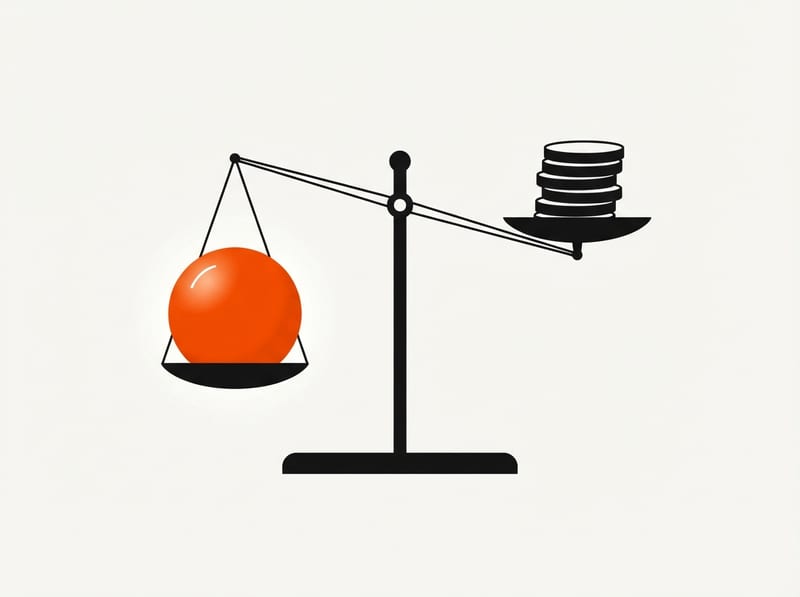
The two numbers describe different things. The $11 billion is money moving into the company. The $1.25 trillion is the price tag placed on the entire business. If the valuation includes the new money, which is the usual convention, $11 billion is under 1 percent of $1.25 trillion. Even $20 billion would be a small slice.
How does a private company get a valuation?
A public company has a price every second, set by buyers and sellers on a stock exchange. A private company has no such market. Its valuation is set when a funding round happens: the company and investors negotiate a price per share, and multiplying that by all shares gives the valuation.
That makes the number a product of negotiation. It reflects growth expectations, competition and how eager investors are to own a piece. Only the shares sold in the round are actually priced by a deal. The rest are assumed to be worth the same.
Why do the numbers move so much?
The reported figures show how sensitive these estimates are. The Verge notes OpenAI raised $122 billion in March at an $852 billion valuation. Bloomberg also reported that OpenAI had initially hoped to raise as much as $30 billion at a $1.4 trillion valuation, before tech stocks dropped and the midterm results showed public opinion turning against AI companies and data center projects.
So the current round, at $1.25 trillion and a possible $20 billion, falls short of the earlier target on both counts. Valuation and amount raised are linked: a lower sentiment means investors may pay less per share or commit less money.
Why does the IPO matter?
An initial public offering, or IPO, is when a company first sells shares to the general public on an exchange. It replaces negotiated prices with a live market price, and it lets early investors sell.