Skip to content
techworthit
techworthit

One question, one number. TechWorthIt reads the world's tech reviews and reporting, then tells you whether it's worth your money, with every source linked.

How we scoreAboutContactPrivacyTermsRSS
© 2026 TechWorthIt · We may earn a commission from links. It never changes a verdict.
LatestReviewsDealsSearchSaved 0
SectionExplainers / Wearables
AuthorTechWorthIt Desk
PublishedNov 15, 2026 · 3 min

How will Apple's smart glasses work with just an iPhone and Siri?

Apple's first glasses reportedly act as a voice and camera front end for the iPhone. Here is how that design works and why it depends on Siri.

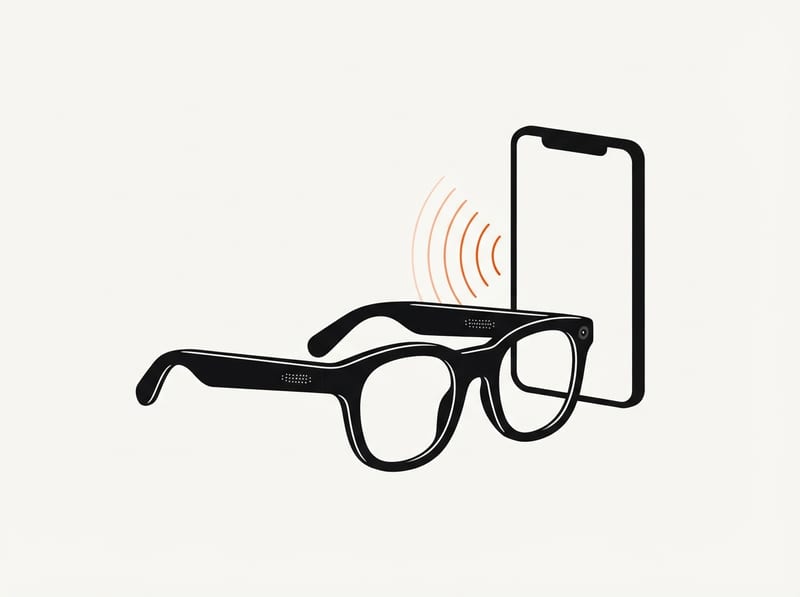
Smart glasses with a small camera on the frame sit beside a smartphone, with curved sound waves flowing from the glasses to the phone.
Illustration
On this page
  1. What does a companion design mean?
  2. Why does Siri carry so much weight?
  3. What do the cameras add?
  4. Why does this approach matter now?
  5. What it means for you
0% read
On this page · 5 sections ▾
  1. What does a companion design mean?
  2. Why does Siri carry so much weight?
  3. What do the cameras add?
  4. Why does this approach matter now?
  5. What it means for you
TL;DR
Apple's first smart glasses are reportedly a companion device: they capture voice and camera input, while a paired iPhone runs the apps and does the heavy processing. That makes Siri's ability to control individual app actions the key technology, not the glasses hardware.

Apple's first smart glasses are reportedly built as a thin front end for the iPhone. The glasses carry cameras, microphones and speakers, while the paired phone runs the apps and does most of the processing. Siri is the link between the two, which is why Apple's software changes matter as much as the frames.

As MacRumors reported, citing Bloomberg's Mark Gurman, Apple plans to unveil the glasses at WWDC in June 2027 and ship them before the end of that year. The first model will not show augmented reality imagery.

What does a companion design mean?

A companion device offloads hard work to something else. Glasses have little room for a large battery, a powerful chip or lots of memory. According to the reports, the prototypes use a processor derived from older Apple Watch chips, plus custom components for wireless connectivity and for processing images as the cameras capture them.

The iPhone fills the gap. When a wearer asks for something, the glasses capture the request and the phone carries it out. MacRumors says the paired phone compensates for the glasses' limited processing power and memory.

The trade-off is dependence. Current plans require a recent iPhone, with no Android support. The glasses do have Wi-Fi, so some functions outside third-party apps, such as audio playback, could continue when the phone is not nearby. They will not work as a fully independent device.

Why does Siri carry so much weight?

There is no screen to tap, so voice is the main way to interact. That requires an assistant that can do things inside apps, not just answer questions.

Apple is addressing this with finer-grained Siri control over app actions. MacRumors says the first iOS 27.3 beta began introducing these controls, using a capability first shown in 2024 and rebuilt on newer AI models. Support for Apple's own apps is planned for December, with third-party support in 2027.

Developers do not need to write a separate glasses app. They expose specific actions in their existing iPhone apps to Siri. Digital Trends lists examples Apple envisions: reservations through OpenTable, rides through Uber or Lyft, coffee orders through Starbucks, shopping on Amazon and movie tickets through Fandango.
Keep reading

News / AI7d

Apple reportedly wants Siri to act more like an AI agent

Bloomberg's Mark Gurman says Apple could give Siri ongoing, goal-tracking abilities as early as 2027, as CEO John Ternus presses for a faster software roadmap.

A smartphone with a glowing orb on its blank screen sits at the start of a winding path leading to a small flag on a distant hill, symbolizing an assistant that pursues goals.
News / Smart Home2d

Apple HomeView and Apple TV 4K go on sale at $299 each

Both devices launched on November 13 with Siri AI, but HomeView skips the EU, the wall-mount version needs a separate bracket, and Siri AI is still in beta.

A small smart home display on a stand beside a compact streaming box and a loose wall-mount bracket.

Related verdicts

Worth it · 8.7
Huawei Watch GT 7 Pro
Worth it · 8.5
Google Fitbit Edge
$180
Worth it · 8.4
Apple Watch Ultra 4
$799

What do the cameras add?

The cameras feed Visual Intelligence, Apple's feature that lets an AI model look at the surroundings and answer questions. On the iPhone, it can answer contextual questions, help with translation or identify items. On the glasses, the reports describe identifying buildings, suggesting meals from the ingredients in a refrigerator, giving directions and translating signs and conversations.

Other planned functions include calls, messages, iPhone notifications, calendars, reminders, music controls and smart home controls. Apple is also reportedly emphasizing audio quality, which employees have called "industry-leading," with support for calls, music and FaceTime audio.

Why does this approach matter now?

Apple is betting on its app ecosystem rather than on standalone hardware. 9to5Mac notes that rivals such as Meta lead in agentic AI assistants, but third-party app integration is weaker. If developers enable Siri actions before launch, the glasses could arrive with many useful tasks already available.

The approach carries risk. Gurman said the hardware is largely settled, but software and AI work is running late and could delay the 2027 launch. The glasses also overlap with camera-equipped AirPods planned for late 2027, which would also give Siri information about the user's surroundings.

What it means for you

If the reports hold, the glasses would be an iPhone accessory first. Owners of a recent iPhone would get the most from them, and Android users would be left out. Whether they succeed depends less on frame design than on how well Siri can complete real tasks in the apps people already use.

The news behind this
Apple smart glasses reportedly set for WWDC 2027 reveal →

Sources

  • The VergeApple’s first smart glasses are coming together↗
  • Digital TrendsApple’s first smart glasses will have you talking with apps through Siri AI in 2027↗
  • 9to5MacApple’s Siri AI smart glasses are reportedly launching next year, here’s what to expect↗
  • MacRumorsApple's Smart Glasses Strategy Hinges on Siri and iPhone Apps↗

HOW THIS WAS MADE · Written by the TechWorthIt Desk with AI assistance from 4 published sources, linked above. Facts are cross-checked against those sources before publishing; we never claim testing we didn't do. Last updated Nov 15, 2026. Spotted an error? Tell us.

News / Wearables3d

Google and Samsung open preorders for Gemini Intelligent Eyewear

The camera-equipped, display-free glasses from Warby Parker and Gentle Monster start at $395, work with iPhones and select Android phones, and ship on December 10.

A pair of camera-equipped smart glasses on a pedestal next to a smartphone and an open shipping box.
News / Business4d

Apple Support Community goes read-only, closes November 20

Apple stopped accepting new posts on November 10 and will shut the 28-year-old user forum permanently on November 20, 2026, without saying what happens to the archive.

A cork bulletin board covered in blank paper notes is secured with a padlock while one note falls toward an open storage box beneath it.
techworthit
01 Reviews02 Explainers03 News