On this page · 5 sections ▾
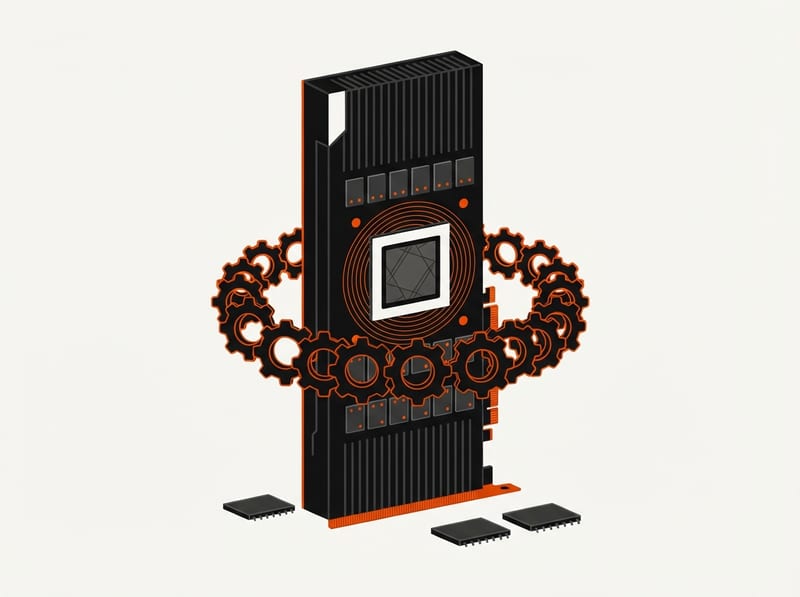
Nvidia dominates AI computing because its graphics processors (GPUs) are built to run enormous numbers of simple calculations at the same time, which is the core workload of modern AI models. Its second advantage is software: CUDA, the programming platform developers use to run code on Nvidia chips, makes switching to a rival expensive in time and effort. As Wired noted in its coverage of Jensen Huang's resignation, the company controlled about 90 percent of the GPU market as of September 2026.
How is a GPU different from a regular processor?
A conventional CPU has a few powerful cores that work through tasks largely one after another. A GPU has a very large number of smaller cores that all work on pieces of a problem simultaneously.
That design came from graphics. Nvidia was cofounded in 1993 by Huang, Chris Malachowsky and Curtis Priem, who aimed to bring realistic 3D graphics to personal computers. Drawing a scene means doing similar math for millions of pixels at once, so parallel hardware was the right tool.
Training and running a neural network involves repeating similar math across huge grids of numbers. That is the same shape of problem, which is why graphics chips turned out to suit AI.
When did GPUs become AI chips?
Wired points to 2012, when a neural network called AlexNet won a high-profile computer vision prize. Huang has described that moment as a "Big Bang" for computing. Nvidia then pivoted from high-speed graphics toward chips that support AI.
The payoff arrived with the broader AI boom. Nvidia's share value soared in 2023 and 2024, and in the summer of 2025 it became the first company to cross $4 trillion in value, according to Wired.
What is CUDA, and why is it called a moat?
CUDA is Nvidia's software platform for programming its GPUs. Wired describes it as a software "moat" that keeps developers locked into Nvidia chips.
The logic is simple. Over time, developers build code, tools and habits around one platform. A competitor can design a capable chip, but customers must still rewrite or retest their software to use it. Hardware performance matters, yet the cost of moving away from the ecosystem often matters more.