On this page · 6 sections ▾
A Neural Accelerator is a small block of circuitry designed to do the repetitive multiply-and-add math at the heart of AI models. In Apple's M6 chip, one sits inside every GPU core, alongside a separate 16-core Neural Engine. The goal is to make AI tasks run faster on the Mac itself, without sending data to a server.
What problem does it solve?
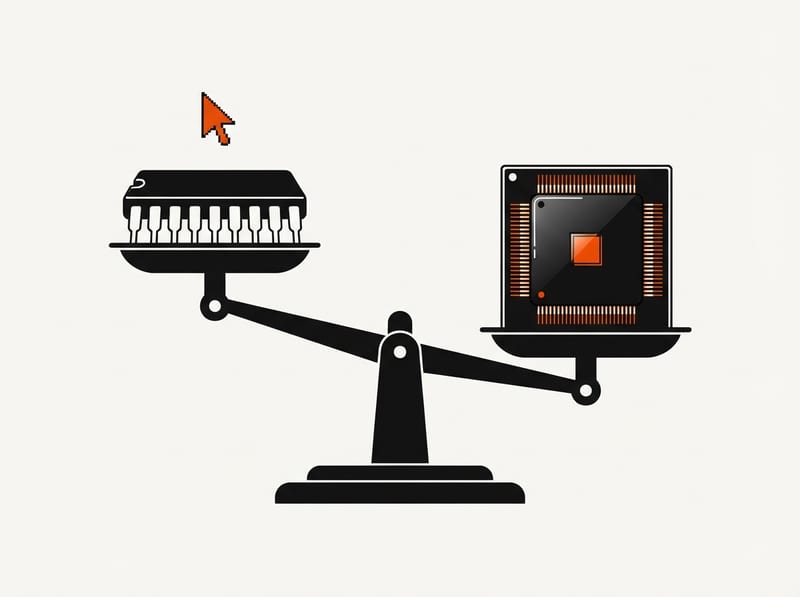
AI models, including the language models behind chatbots, are mostly huge grids of numbers multiplied together. A general-purpose CPU can do this, but slowly. A GPU is better because it runs thousands of small calculations in parallel. Dedicated hardware for exactly this kind of math is faster still, and uses less energy per calculation.
Apple already had a Neural Engine, a separate processor for such work. The change in the M6 is that the acceleration is also built into the GPU, as The Next Web described it: each GPU core has a Neural Accelerator, and the two work alongside the 16-core Neural Engine.
Why put it inside the GPU?
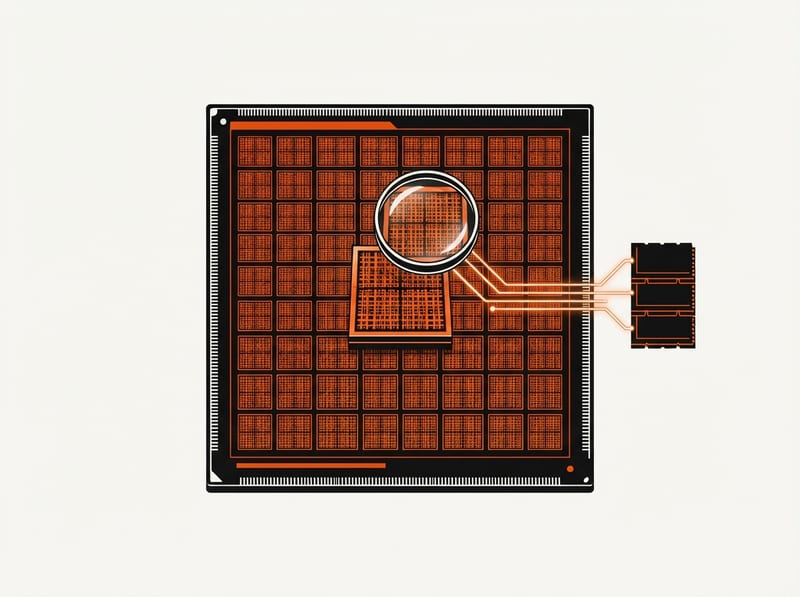
Many AI tasks on a computer share the GPU with graphics, video and image editing. If the AI math hardware lives inside the GPU cores, those cores can switch between drawing pixels and crunching model data without handing work across the chip. The more GPU cores a chip has, the more accelerators it has, so the AI capacity grows with the graphics hardware.
The M6 has a 12-core CPU and a 12-core GPU, according to TechCrunch. The Register adds that the chip is built on TSMC's 2nm process.
What do the speed claims actually measure?
Apple's headline AI numbers refer to prompt processing, which is the step where a local model reads and digests the text you give it before it starts answering. Macworld reports Apple's claim of up to 5x faster on-device AI prompt processing in LM Studio on the new iMac compared with the M4 model. TechCrunch reports up to 13 times the LLM prompt-processing speed of the M1 MacBook Pro, and up to 1.3 times the speed of the M5 model.
All of these are Apple's own figures, and none has been independently tested yet. The gap between comparisons is also telling: the jump from M5 to M6 is modest, while the jump from older chips is large, partly because accelerators like this did not exist in earlier generations.
What still limits local AI?
Faster math does not remove every bottleneck. Two others matter.